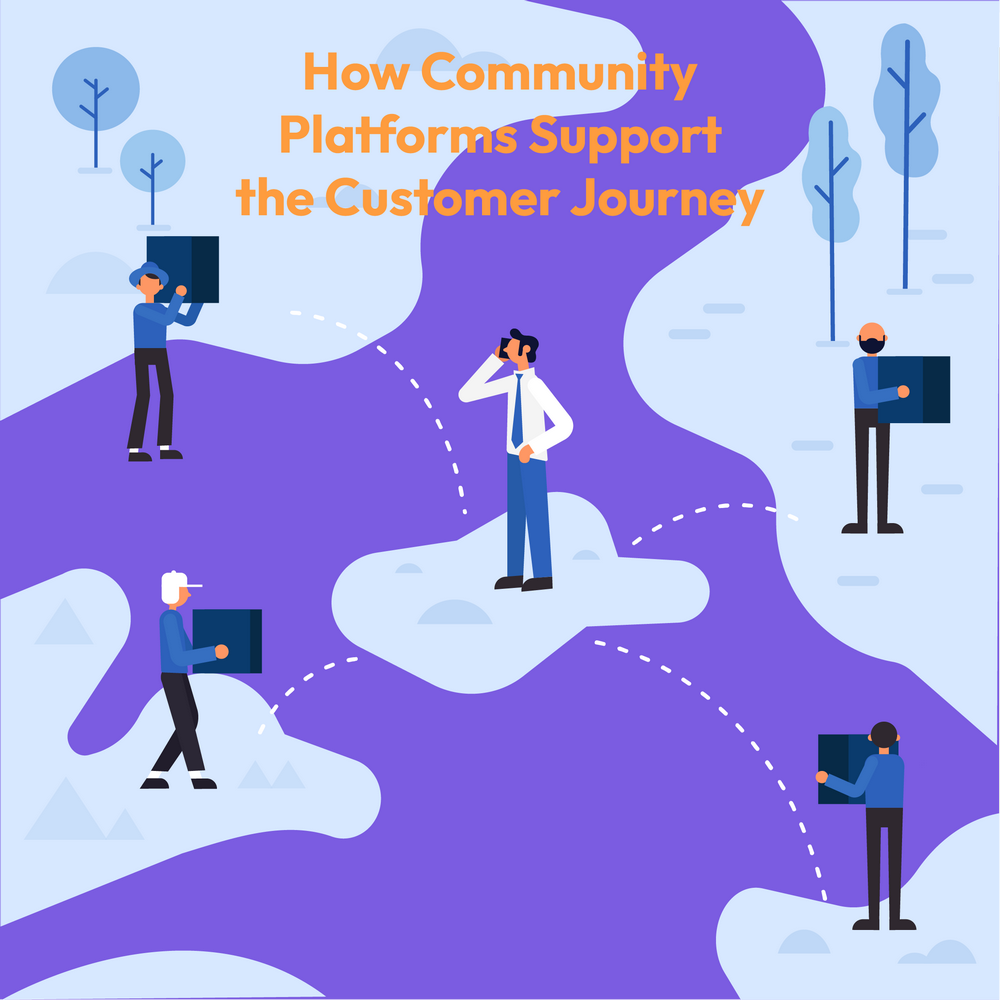

How Community Platforms Support the Customer Journey
From Funnel to Flywheel: Why Community Has Become a Growth Lever
The traditional marketing funnel is starting to feel like a relic. The neat, linear path: awareness, consideration, purchase, loyalty, has unraveled into something far messier and more human. Today, customers move through loops of influence, conversation, and shared experience long before they reach a sales page.
That’s why leading brands are shifting from funnel thinking to flywheel design, where the energy that drives growth comes from customers, not campaigns. Every interaction inside a community (whether it’s a shared tutorial, a product critique, or a peer recommendation) adds kinetic force to that wheel. The more people participate, the faster it spins.
Community as the Continuous Customer Journey
Community has become the connective tissue of that flywheel. It’s no longer a “post-sale support” space. It’s part of the full journey, from first impression to lifelong advocacy.
Buyers trust each other far more than they trust polished marketing. 89% of consumers say they trust recommendations from people they know above any form of advertising. That single shift explains why communities have become the new front line of brand influence: they turn authentic peer experience into public proof.
Harvard Business Review calls this “community as competitive advantage,” arguing that connection now matters more than differentiation. Brands like Notion, Figma, and Duolingo have proved that communities drive growth not through loyalty programs or ad spend, but by turning participation itself into a product feature.
The Flywheel in Practice
Mighty Networks describes the community flywheel as a loop powered by five forces:
- Focus on niche communities
- Elevate “hero” products that inspire advocacy
- Share authentic stories
- Encourage member-created content
- Make engagement frictionless
It’s about designing participation so that trust compounds with every interaction.
The lesson is clear: your next phase of growth won’t come from how loudly you talk about your product. It’ll come from how effectively you help customers talk to each other.
Awareness: Turning Shared Interests into Brand Discovery
Before anyone lands on your website, they’ve probably already entered your orbit. Awareness today begins with affiliation.
People now discover brands through the shared interests, problems, and passions that bring them together online. A designer joins a Figma forum to swap tips, a marketing ops manager follows a RevOps Slack channel, a fitness enthusiast joins a Strava group for accountability. Somewhere inside those interactions, product awareness starts to form naturally. Not as a pitch, but as a peer recommendation in motion.
Awareness Is Now Community-Powered
Social algorithms still matter, but it’s communities that create lasting awareness. The difference is intent: in a feed, people scroll. In a community, they search, ask, and contribute. That distinction changes how discovery happens.
When someone encounters your brand in a space built around shared interests or challenges, it feels like a recommendation. A comment thread, a resource exchange, or a problem-solving discussion can introduce your product more effectively than a sponsored post ever could.
That’s because discovery inside a community carries context and credibility. The brand isn’t claiming value; peers are demonstrating it. Those moments of organic exposure stay with people longer, because they’re tied to relevance, not interruption.
From Interest Graphs to Influence Graphs
Communities function as interest graphs. Networks are organized around shared challenges rather than demographics. The smartest brands treat those graphs as listening posts, not lead generators. They observe the language people use, the problems they prioritize, and the solutions they trade. That intelligence shapes how the brand shows up later: relevant, empathetic, already part of the conversation.
When a prospective customer encounters your product in that context, it doesn’t feel like discovery. It feels like recognition.
Real-World Example: How Miro Turns Creativity Into Community
Miro’s community is a live engine of creativity and discovery. Over a thousand “Miroverse Creators” connect through messaging apps, social channels, and events like Into the Miroverse to share templates, workflows, and ideas that make collaboration more joyful and effective.
What’s notable isn’t the size of the community, but its function. Members don’t simply use Miro; they extend it. Facilitators and designers remix each other’s templates, build new frameworks, and trade facilitation tools that thousands of others adopt. Projects like “Enotejis,” a playful reimagining of digital sticky notes, or the “Miro Board Improv” sessions where community leaders co-create in real time, show how collective creativity fuels product discovery.
For many professionals, their first exposure to Miro comes through these community-driven resources, not a sales page. By the time they sign up, they already understand how the product works and why it matters, because they’ve seen it in use by peers solving real problems.
That’s what makes Miro’s ecosystem so effective at the awareness stage: the community doesn’t market the product; it embodies it.
Consideration: Where Credibility Is Crowdsourced
The middle of the customer journey used to be a private process: a potential buyer quietly compared specs, read a few reviews, and maybe filled out a form for a demo. That’s no longer how trust forms.
Today, credibility is a collective project. Prospective customers look to communities, not just for opinions, but for evidence. They read the comments under tutorials, watch how power users talk about a feature, or join user forums to see if others face the same challenges. That behavior validates their decision.
The New Proof Layer
Communities serve as a kind of live reference library, a transparent archive of real experiences that brands can’t script. When someone asks, “Has anyone tried this integration?” and another member answers with screenshots and outcomes, that exchange carries more weight than any marketing claim. It’s living proof.
This is also the phase where authenticity meets risk. The same openness that builds credibility can expose flaws. That’s why the most effective community teams curate honesty. They step in when needed to clarify facts, but they let peers speak freely, even when feedback is imperfect.
Operational Nuance: Balancing Trust and Brand Safety
It’s easy to talk about transparency; it’s harder to operationalize it. The friction comes from brand teams who worry that unfiltered discussions might “hurt perception.” But in practice, attempts to over-moderate usually do the opposite. Members sense when a space is being managed for optics instead of truth, and the credibility advantage disappears.
The best community managers operate like editors, not gatekeepers. They keep dialogue productive and respectful but leave room for friction, because that’s where real trust forms.
Letting Go of Control
Consideration, at its core, is about confidence transfer. People gain confidence in your product when they see others using it with conviction. That can’t be manufactured, and it can’t be polished.
When a potential buyer sees customers helping each other solve problems, or even constructively critiquing your product, they interpret it as honesty, and honesty reads as safety. That’s why strong communities consistently outperform paid campaigns in moving prospects from interest to intent.
The brands that thrive here don’t speak for their users. They build the stage, then step back.
Purchase: From Engagement to Conversion Without the Hard Sell
By the time someone’s ready to buy, they’ve often been part of the conversation for weeks or months. The sale happens quietly. Not after a pitch, but after a pattern.
When you watch active communities closely, you see this dynamic play out: a newcomer joins to learn, asks a few questions, experiments based on advice from peers, and then makes the purchase almost as an afterthought. They’re not “converting” in the traditional sense. They’re catching up to a decision the community already normalized.
How Advocacy Becomes Acceleration
A single comment thread can do more to close a deal than an entire drip campaign. When existing users share screenshots, results, or templates, they create implicit endorsements. Credible proof that the product delivers. These moments of authenticity are contagious. They lower hesitation because they show, not tell.
That’s why the best community-led brands design spaces where those proofs can surface naturally. They create occasions for participation that make the product visible in action.
Examples include:
- Live AMAs with experienced users explaining how they solved real problems.
- Community-only product previews or betas, where members get early access and shape features before launch.
- Shared showcases, where customers post what they’ve built or learned.
These interactions blend engagement with gentle enablement. Members feel invited into a circle of practice.
Turning Conversations Into Conversion Cues
From an operational standpoint, communities shorten the sales cycle by replacing persuasion with peer-level validation. Prospects already understand use cases, outcomes, and trade-offs before ever talking to sales. The sales conversation then becomes about fit, not convincing.
The important nuance: this only works if participation is authentic. The moment community spaces become funnels in disguise, credibility collapses. Smart operators keep the walls thin between community and commerce but maintain transparency about which is which.
The Subtle Art of Not Selling
The real skill here is building conditions where buying feels natural. When people trust the group, value the conversations, and see peers succeeding with the product, the purchase decision feels obvious.
To make that happen, focus on these fundamentals:
- Design moments of shared success. Encourage members to post what they’ve built or learned. Celebrate their results, not your features.
- Keep expertise visible. Invite experienced users to lead discussions or host quick demos. Peer authority beats polished messaging every time.
- Be transparent about intent. If a session or thread is tied to a product launch, say so. Audiences appreciate honesty more than spin.
- Reward contribution over conversion. Recognize helpful members publicly (shoutouts, access, or small privileges) so the culture stays about giving, not selling.
- Let stories travel. Package community-created examples into newsletters or posts (with permission). Amplify what the community already proves.
When you design for these behaviors, you don’t need to push people toward purchase. They arrive there themselves. Guided by peers, not persuasion.
At that point, conversion isn’t an event. It’s the next logical step in belonging.
Retention and Loyalty: Building Emotional Stickiness
Getting someone to buy is one thing. Getting them to keep buying is something else entirely. The real work of community begins after the purchase. When the novelty fades and you’re left with the harder, slower task of helping people find continuous meaning in the relationship.
Beyond Retention Tactics
Most post-sale programs focus on reward points, updates, or customer newsletters. But those are transactional tools, not emotional ones. True loyalty grows when customers feel connected to a shared pursuit (learning, mastery, progress, or purpose) that extends beyond the product itself.
Communities are the infrastructure for that feeling. They give customers a place to keep learning, sharing, and evolving alongside others who understand their goals. It’s about belonging that reinforces value over time.
How to Keep the Momentum After the Honeymoon
There’s always a quiet drop-off after initial excitement. The best operators plan for it instead of panicking about it. Sustaining a community means giving people reasons to re-engage that feel fresh but familiar.
A few effective approaches:
- Create recurring rituals. Weekly challenges, open Q&As, or themed discussions help people make participation a habit.
- Highlight real progress. Showcase member milestones or case studies. Seeing growth reflected back makes people want to keep contributing.
- Build small circles inside the big one. Peer pods or special-interest channels deepen relationships and reduce churn.
- Rotate voices. Feature members as guest hosts or content contributors. It keeps the energy dynamic and the ownership distributed.
The Emotional Flywheel
Retention is rarely about product satisfaction alone. It’s about emotional continuity. The sense that a brand is part of a person’s identity, not just their toolkit. Communities achieve that by making customers feel seen at the moments when marketing usually goes quiet.
When people experience that kind of recognition, when their contribution becomes part of the collective story, they don’t just stay customers. They stay connected.
That’s how communities create something even stronger than retention: stickiness rooted in shared progress.
Advocacy: Turning Customers into Brand Builders
When a community reaches maturity, something powerful happens: your most engaged members start doing the work marketing teams used to do. Not because they’re asked to, but because they want to.
That’s advocacy. Not a campaign, but a cultural reflex. People champion the brand because it reinforces how they see themselves.
From Loyalty to Leadership
Advocacy emerges from alignment. When members see their own success tied to the community’s success, the line between customer and ambassador disappears.
Brands like Notion, Figma, and HubSpot built their ecosystems on this principle. They created conditions where advocacy became inevitable:
- Members could contribute templates, tools, and educational content that others relied on.
- The brand actively celebrated user contributions instead of dominating the narrative.
- Power users gained status and visibility that extended beyond the platform itself.
In that environment, advocacy is self-expressive.
Turning Advocacy Into a System
You can’t manufacture enthusiasm, but you can design for it. The most effective community-led brands build quiet frameworks that give advocacy a place to live:
- Spotlight contributions publicly. Feature community-created resources or stories in newsletters, product updates, or events.
- Empower creativity. Offer toolkits, media assets, or open APIs that let members create and share their own takes on your product.
- Recognize leadership early. Formalize ambassador or creator programs that reward initiative, not influence.
- Keep feedback loops open. Advocates need proximity to the brand team. Regular syncs, private channels, or early access opportunities make their input visible.
These systems turn individual energy into collective acceleration.
Advocacy as an Output, Not an Ask
The mistake many brands make is trying to solicit advocacy. Sending “please share this” campaigns or dangling rewards for referrals. That’s not advocacy; that’s affiliate marketing.
True advocacy is a byproduct of trust. It happens when customers feel seen, heard, and valued enough to take ownership of the story themselves.
When you reach that point, your marketing flywheel starts turning on its own. Customers become part of its creation.
And the most persuasive story any brand can tell is the one its users are already living.
Final Take: The Customer Journey Is Now a Collective Experience
The customer journey no longer belongs to the brand. It belongs to the network of people who live it, shape it, and share it with one another.
Community platforms have changed how growth happens. From first awareness to lifelong advocacy, every stage of the journey is now powered by participation.
The most effective brands don’t chase conversions through content. They cultivate ecosystems of confidence. They invest in spaces where customers learn, build, and succeed together, because those are the spaces where trust compounds.
That’s the real evolution: marketing isn’t something you broadcast anymore. It’s something you host.
And the brands that understand that are building momentum.